
Catholic Mass in Tagalog With English Translation
How a parish can hold a Tagalog Mass that the whole family follows: the homily on each phone in English or Filipino, prayers as Filipinos pray them.
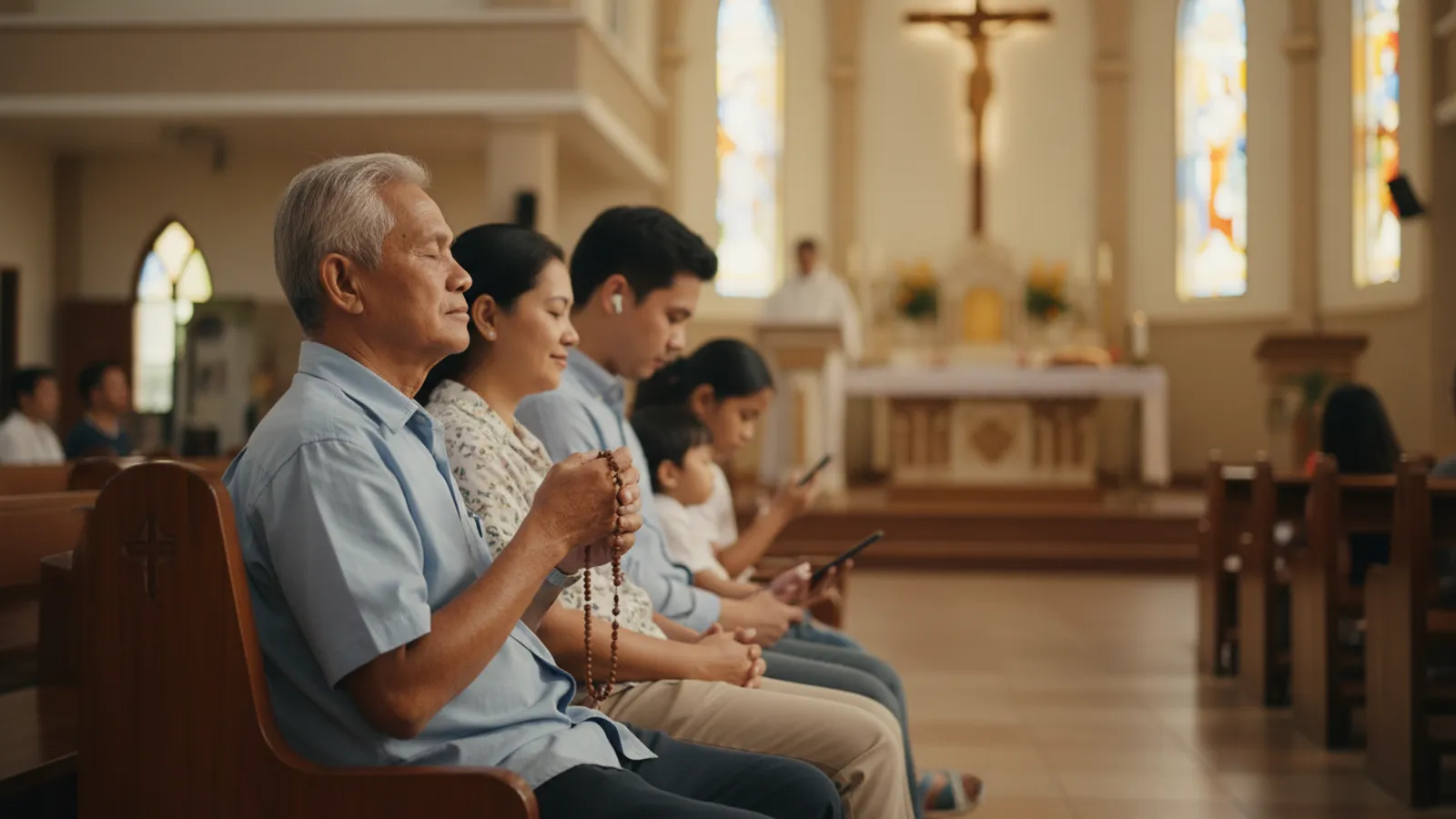
In parishes in Los Angeles, Toronto, London, Dubai or Sydney, the monthly Tagalog Mass is often the fullest Mass on the calendar. A Filipino priest or a visiting chaplain celebrates, the choir sings the songs everyone learned at home, and afterwards there is food in the parish hall.
The people in the pews do not all share one language. Grandparents and newly arrived nurses and caregivers pray in Tagalog. Their children grew up in English. A husband or wife from another background comes every month and understands the songs but not the homily. And at the parish's English Mass, Filipino families who are still more at home in Tagalog sit next to everyone else and follow less than they would like.
This guide is for the priests, Filipino ministry leaders and parish staff who plan a Catholic Mass in Tagalog: what a worship aid can cover, what it cannot, and how to let every family follow the homily in the language they understand.
What stays the same, and what a worship aid covers
The order of the Mass is the same in Tagalog and in English. Someone who knows the English Mass knows when to stand, when to sit and when to answer, even if they do not know the words. Two dialogues show how familiar the shape is:
| Tagalog | English |
|---|---|
| Sumainyo ang Panginoon. At sumaiyo rin. | The Lord be with you. And with your spirit. |
| Ang Salita ng Diyos. Salamat sa Diyos. | The word of the Lord. Thanks be to God. |
For the other responses, copy the wording from the Tagalog missal your priest uses, so the worship aid matches what is said at your altar. A card with the responses side by side helps a non-Filipino spouse join in, and helps children raised in English answer with their grandparents.
What a card cannot cover
The readings. They change every Sunday, and few people open a bilingual missalette during Mass.
The homily. It is never printed in advance, and it is the part that speaks to the family's week.
The announcements. The Simbang Gabi schedule, the Santo Niño feast in January, a novena, the parish fiesta, a wake for a member of the community. At a Tagalog Mass they are said in Tagalog, and they are exactly what the English-speaking members of the family need to hear.
So the real question is how to let someone follow the homily and the announcements live.
Three ways to translate a Tagalog Mass
A bilingual Mass. Readings alternate, and the homily is split or given twice. It fits a feast day. Every month it makes Mass longer, and it needs a priest who preaches comfortably in both languages. Our article on the bilingual Mass goes into the details.
A human interpreter. A bilingual parishioner interprets the homily into a microphone for listeners with receivers and headsets. With a skilled volunteer who comes every time, this works. But receivers need charging and collecting, and when the volunteer is away, the translation stops.
Live interpretation on listeners' phones. A laptop at the sound desk takes the audio from the mixer. Listeners scan a QR code, choose English or Filipino, and follow the homily with captions and a natural AI voice, about two seconds after each sentence ends. No receivers and no app to install.
That last option is what Heartongue does. One broadcast serves several languages at once, from 49 languages, so the same Tagalog Mass can be followed in English by one listener and in Spanish or Vietnamese by another. Filipino priests often move between Tagalog and English within one homily, sometimes within one sentence. Heartongue detects the language of every sentence, so the English listener keeps hearing English and the Filipino listener keeps hearing Filipino.
It is machine interpretation, and it is not perfect. A name, a joke that depends on a pun, or a sentence lost in poor audio can come out wrong. For confession, marriage preparation or a pastoral visit, a priest who speaks the language is the right answer. For following the homily every month, phones are often the most practical choice a parish has.
Why the translation has to sound Catholic
A general translation app pointed at the ambo translates word for word, makes up its own Bible wording and mixes Catholic and Protestant vocabulary. Filipino listeners notice, because Filipino Catholics and Filipino Protestants pray the same prayers with different words.
Prayers as Filipinos pray them. When the congregation prays the Our Father in English, the Filipino listener does not read a fresh machine translation. They read the Ama Namin the way Filipino Catholics pray it, beginning "Ama namin, sumasalangit Ka". Many Filipino Protestant churches begin "Ama namin na nasa langit Ka" and end with the doxology. The Catholic prayer ends where the Mass ends it:
English (prayed aloud): "And lead us not into temptation, but deliver us from evil."
Filipino, for a Catholic parish: "At huwag Mo kaming ipahintulot sa tukso, at iadya Mo kami sa lahat ng masama."
The same goes for the Hail Mary, which a lola has said on every bead of every rosary as "Aba Ginoong Maria, napupuno ka ng grasya", and for the Creeds and the Glory Be. Heartongue follows the tradition of the room.
Catholic words for Catholic listeners. The Mass, the Eucharist, Mary and the saints are named the way a Catholic expects. Heartongue knows more than 1,000 church terms in every language, and your team can add the names of your priests, your Filipino ministry, your patron saint and your feasts to a glossary, even during Mass.
Bible verses from a Bible. When the homilist quotes a verse, the listener reads it from a Bible in their own language, marked 📖 with the reference. Take John 6:35, a verse heard often in homilies on the Eucharist:
English (World English Bible, Catholic edition): "I am the bread of life. Whoever comes to me will not be hungry, and whoever believes in me will never be thirsty."
Filipino (Banal na Bibliya, ULB): "Ako ang tinapay ng buhay, ang lalapit sa akin ay hindi magugutom at ang sumampalataya sa akin ay hindi mauuhaw kailanman."
An honest limit: the Tagalog Lectionary used at Mass is a licensed Catholic translation that Heartongue does not include. Heartongue ships 37 free, public-domain or openly licensed Bibles, and the Filipino one is the Banal na Bibliya (ULB), an openly licensed translation used across traditions. A quoted verse reads correctly, but not word for word as in the Lectionary.
Another limit: Heartongue interprets into Filipino (Tagalog). Elders whose first language is Cebuano, Ilocano or another Philippine language will hear Filipino, which most understand, but it is not their mother tongue.
Natural, not robotic. Sentences stay whole, idioms are translated by meaning, and an announcement about the fiesta sounds like everyday talk.
Setting it up for the next Tagalog Mass
- Get clean audio. Run a line from the mixer into a laptop at the sound desk. A line feed is far better than a microphone listening to the room.
- Create a room for the Mass. Each room has a permanent QR code and link. Print it once on the worship aid and at the entrance.
- Say it once before Mass. "If you would like to follow the homily in English, scan the code on the card." At the English Mass, the same sentence in Tagalog.
- Use a screen if it helps. A presenter screen can show the captions in the parish hall, for elders who prefer to read or anyone whose phone battery died.
- Ask for feedback. After two Masses, ask a few bilingual parishioners what came out wrong, and add those names and words to the glossary.
Listeners need earphones for the voice, or they can simply read the captions.
What it costs
Heartongue counts language-hours: one hour of broadcasting in one language that someone is actually listening to. A one-hour Tagalog Mass followed in English uses one language-hour. Languages nobody listens to are not charged.
Every parish starts with 2 free language-hours, enough to try it at a real Mass. After that it is $4 per language-hour, the Chapel plan at $49 a month with 15 hours, or the Parish plan at $149 a month for every regular Mass in every language your parishioners need. All plans are on the pricing page.
Start with one Mass
Pick the Tagalog Mass where you already see spouses and grandchildren who do not follow the homily, or the English Mass where Filipino elders sit near the back. Try it twice and ask those families what changed. With Simbang Gabi starting on December 16, a test this month means the setup is ready for the novena; our guide to Simbang Gabi in English covers the planning. See how Heartongue handles Filipino translation for church, or the full list of languages it supports.
More from the blog
Order of the Mass in Spanish: The Parts and Their Names
Heartongue8 min read
The order of the Mass in Spanish, part by part, with the Spanish name of each part, who leads it and what changes every week, for parish planners.
Catholic Mass in Polish With English Translation
Heartongue8 min read
The Mass responses in Polish and English side by side, and how a parish can let families follow a Polish Mass homily in English, or an English one in Polish.
Simbang Gabi in English: Planning a Bilingual Novena
Heartongue8 min read
How a parish can hold Simbang Gabi for Filipino families and everyone else: English or Tagalog, the homily on each phone, prayers as Filipinos pray them.
Try it at your next service
2 language-hours free, no card needed. Set up a room in five minutes.
 Product Hunt
 Indie Hackers
 Fazier
 StartupBase
 SaaSHub