
Catholic Mass in Polish With English Translation
The Mass responses in Polish and English side by side, and how a parish can let families follow a Polish Mass homily in English, or an English one in Polish.
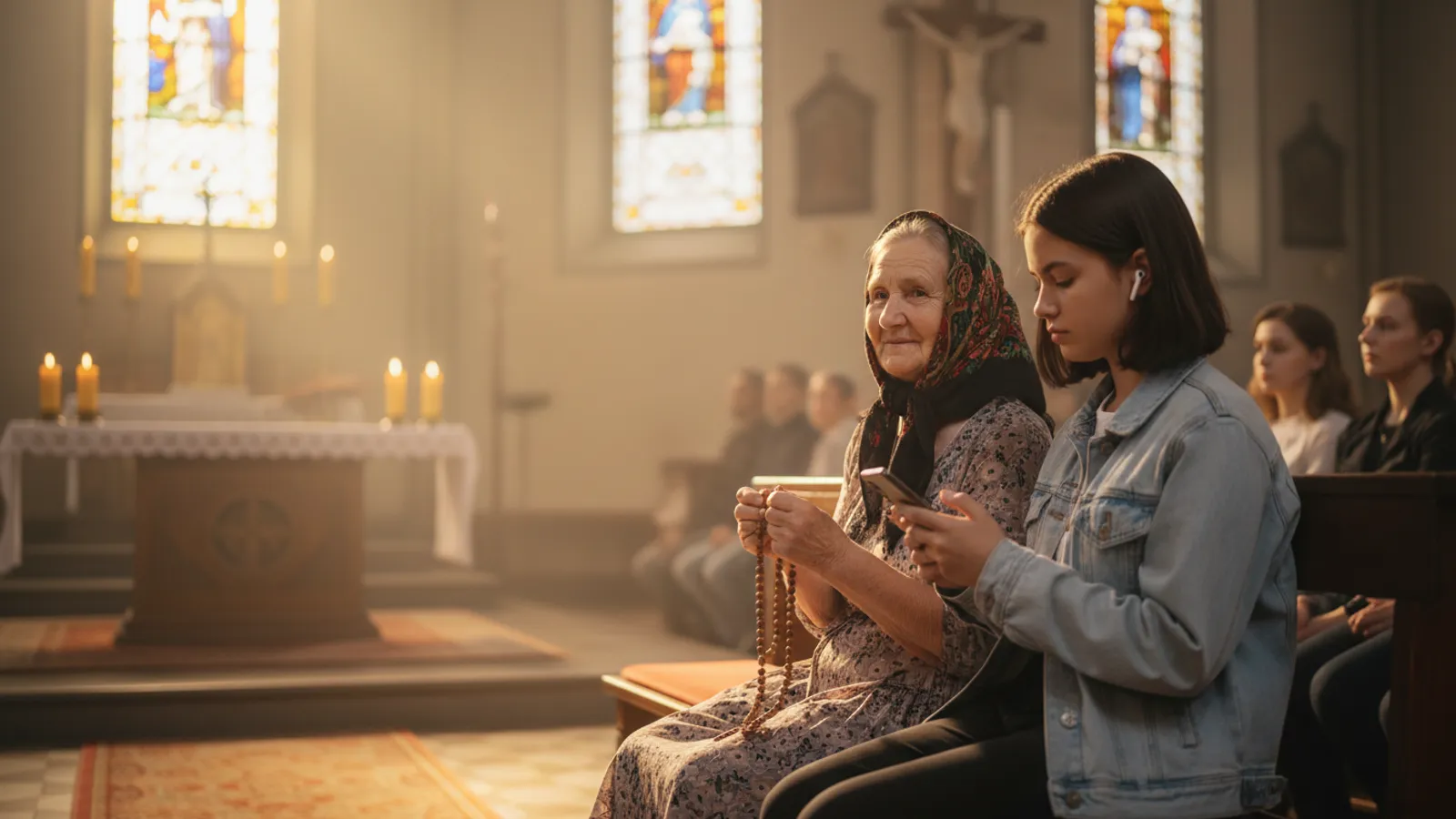
In many parishes in Chicago, New York, London, Dublin or Toronto, the Polish Mass is the fullest Mass of the weekend. A Polish chaplain or a priest of the Polish Mission celebrates it, the choir sings the hymns everyone knows from home, and the community stays for coffee afterwards.
It also brings together people who do not share one language. Grandparents who came decades ago pray in Polish. Their grandchildren grew up in English and know the prayers but not the homily. Polish workers who arrived last year are still learning English. And at the parish's English Mass, Polish families sit next to everyone else and follow less than they would like.
This guide is for both sides of a Catholic Mass in Polish: the responses people can learn, the parts a card cannot cover, and how to let every family follow the homily in the language they understand.
The Mass responses in Polish and English
The order of the Mass is the same in every language, so the fixed dialogues can be learned. These are the ones heard at every Mass, from the Polish Missal and the English Roman Missal:
| Polish | English |
|---|---|
| Pan z wami. I z duchem twoim. | The Lord be with you. And with your spirit. |
| Oto słowo Boże. Bogu niech będą dzięki. | The word of the Lord. Thanks be to God. |
| Oto słowo Pańskie. Chwała Tobie, Chryste. | The Gospel of the Lord. Praise to you, Lord Jesus Christ. |
| W górę serca. Wznosimy je do Pana. | Lift up your hearts. We lift them up to the Lord. |
| Dzięki składajmy Panu Bogu naszemu. Godne to i sprawiedliwe. | Let us give thanks to the Lord our God. It is right and just. |
| Idźcie w pokoju Chrystusa. Bogu niech będą dzięki. | Go in peace. Thanks be to God. |
Look at the Gospel response. "Chwała Tobie, Chryste" word for word is "Glory to you, Christ", yet English Catholics answer "Praise to you, Lord Jesus Christ". Each language has its own approved liturgical wording, and that is the wording people know by heart. A word-for-word translation of the Mass never sounds like the Mass.
A printed card with this table works well. It does not help with the parts that change every week.
What a card cannot cover
The readings. They change every Sunday. A bilingual missalette helps the few who open it.
The homily. It is never printed in advance, and it is the part that speaks to the week the family is living.
The announcements. First Communion classes, the blessing of Easter baskets on Holy Saturday, the Christmas Eve Wigilia, the parish trip, a funeral. At a Polish Mass they are said in Polish, and they are exactly what the English-speaking members of the family need to hear.
So the real question is how to let someone follow the homily and the announcements live.
Three ways to translate a Polish Mass
A bilingual Mass. Readings in one language, the Gospel in both, the homily split or given twice. It fits a feast day or a parish celebration. Every week it makes Mass longer and needs a priest who preaches comfortably in both languages. Our article on the bilingual Mass goes into the details.
A human interpreter. A bilingual parishioner interprets the homily into a microphone, and listeners wear receivers and headsets. With a skilled volunteer who can come every week, this works well. The interpreter does not really attend the Mass they serve, the receivers need charging and collecting, and when the volunteer is away, the translation stops.
Live interpretation on listeners' phones. A laptop at the sound desk takes the audio from the mixer. Listeners scan a QR code, choose English or Polish, and follow the homily with captions and a natural AI voice, about two seconds after each sentence ends. No receivers and no app to install.
That last option is what Heartongue does. One broadcast serves several languages at once, from 49 languages, so the same Polish Mass can be followed in English by one family and in Ukrainian or Spanish by another. If the priest moves between Polish and English in the same homily, Heartongue detects the language of every sentence and keeps going.
It is machine interpretation, and it is not perfect. A surname or a sentence lost in poor audio can come out wrong. For confession, marriage preparation or a pastoral conversation, a priest who speaks the language is the right answer. For following the homily every Sunday, phones are often the most practical choice a parish has.
Why the translation has to sound Catholic
A general translation app pointed at the ambo translates word for word, makes up its own Bible wording and mixes Catholic and Protestant vocabulary. Polish listeners notice all three at once.
Catholic words for Catholic listeners. A Polish Lutheran goes to the nabożeństwo, listens to the pastor and receives the Wieczerza Pańska. A Polish Catholic goes to Msza Święta, listens to the ksiądz and receives Komunia Święta, and Mary is Najświętsza Maryja Panna. When an English homily is followed in Polish at a parish, Heartongue uses the Catholic words, the ones the listener hears at every Mass. It knows more than 1,000 church terms in every language, and your team can add the names of your parish, your patron saint and your feasts to a glossary, even during Mass.
Prayers as the parish prays them. When the congregation prays the Our Father in English, the Polish listener does not read a fresh machine translation. They read the Ojcze nasz as Polish Catholics pray it:
English (prayed aloud): "And lead us not into temptation, but deliver us from evil. Amen."
Polish, for a Catholic parish: "I nie wódź nas na pokuszenie, ale nas zbaw ode złego. Amen."
A Polish Protestant congregation goes on with "albowiem Twoje jest królestwo i moc, i chwała na wieki wieków". A Catholic one does not, and Heartongue follows the tradition of the room. The same goes for the Hail Mary ("Zdrowaś Maryjo, łaski pełna, Pan z Tobą"), the Creeds and the Glory Be.
Bible verses from a Bible. When the homilist quotes a verse, the listener reads it from a Bible in their own language, marked 📖 with the reference. Take John 14:27, heard at every Mass before the sign of peace:
English (World English Bible, Catholic edition): "Peace I leave with you. My peace I give to you; not as the world gives, I give to you."
Polish (Uwspółcześniona Biblia Gdańska): "Pokój zostawiam wam, mój pokój daję wam; daję wam nie tak, jak daje świat."
An honest limit: the Polish Lectionary uses the Biblia Tysiąclecia, a licensed Catholic edition that Heartongue does not include. Heartongue ships 37 free, public-domain or openly licensed Bibles, and the Polish one is the Uwspółcześniona Biblia Gdańska, a modernized version of a classic Protestant translation. A quoted verse reads correctly, but not word for word as in the Lectionary, and some names and turns of phrase will feel less familiar to Catholic ears.
Natural, not robotic. Sentences stay whole, idioms are translated by meaning, and an announcement about the parish festyn sounds like everyday talk, not Scripture.
Setting it up for Sunday
- Get clean audio. Run a line from the mixer into a laptop at the sound desk. A line feed is far better than a microphone listening to the room.
- Create a room for the Mass. Each room has a permanent QR code and link, so you can print it once for the bulletin and the entrance.
- Say it once before Mass. "If you would like to follow the homily in English, scan the code on the card." At the English Mass, the same sentence in Polish.
- Use a screen if it helps. A presenter screen can show the captions in the parish hall or for older parishioners who prefer to read.
- Ask for feedback. After two Sundays, ask a few bilingual parishioners what came out wrong, and add those names and words to the glossary.
Listeners need earphones for the voice, or they can simply read the captions.
What it costs
Heartongue counts language-hours: one hour of broadcasting in one language that someone is actually listening to. A one-hour Polish Mass followed in English uses one language-hour. Languages nobody listens to are not charged.
Every parish starts with 2 free language-hours, enough to try it at a real Mass. After that it is $4 per language-hour, the Chapel plan at $49 a month with 15 hours, or the Parish plan at $149 a month for every regular Mass in every language your parishioners need. All plans are on the pricing page.
Start with one Mass
Pick the Polish Mass where you already see grandchildren who do not follow the homily, or the English Mass where Polish families sit at the back, try it for two Sundays, and ask those families what changed. See how Heartongue works as a church translation system without receivers, the languages it supports, or how parishes do the same for an Italian Mass and a French Mass.
More from the blog
Order of the Mass in Spanish: The Parts and Their Names
Heartongue8 min read
The order of the Mass in Spanish, part by part, with the Spanish name of each part, who leads it and what changes every week, for parish planners.
Catholic Mass in Tagalog With English Translation
Heartongue8 min read
How a parish can hold a Tagalog Mass that the whole family follows: the homily on each phone in English or Filipino, prayers as Filipinos pray them.
Simbang Gabi in English: Planning a Bilingual Novena
Heartongue8 min read
How a parish can hold Simbang Gabi for Filipino families and everyone else: English or Tagalog, the homily on each phone, prayers as Filipinos pray them.
Try it at your next service
2 language-hours free, no card needed. Set up a room in five minutes.
 Product Hunt
 Indie Hackers
 Fazier
 StartupBase
 SaaSHub